
WhatsApp marketing has become a major growth channel for businesses in India. From small local stores to large enterprises, companies use it to acquire new customers, send updates, promote offers, and maintain ongoing relationships. But behind these simple messages, there is a structured system that manages communication at scale.
This blog explains how the WhatsApp marketing system works for businesses of any size in 2026.
Why Most Businesses Misunderstand WhatsApp Marketing
Many businesses in India treat WhatsApp marketing like cold calling. They collect random numbers and send bulk messages hoping to get new customers. Most of them don’t even follow the predefined rules set by the Telecom Regulatory Authority of India (TRAI).
They assume WhatsApp is just another “SMS tool.”
The logic is simple in their mind:
We have numbers → we send messages → we get sales.
But WhatsApp marketing does not work like that.
It is not a shortcut system to print money without consent. It is a structured infrastructure. When businesses ignore this and send promotional messages without proper authorization, their accounts eventually get blocked.
Some try to bypass the system using number rotation, cloned WhatsApp Web automation, or unofficial tools. But these methods are easily detected because the platform is built around strict compliance rules. It involves opt-in permission, the 24-hour messaging rule, approved templates, and official WhatsApp Business verification.
WhatsApp was never designed as a spam broadcast channel. It is a permission-based, conversational relationship platform. Businesses that fail to understand this often damage their own credibility instead of building trust.
The Three Layers of WhatsApp Messaging Infrastructure
The Infrastructure of Whatsapp marketing is built to make users feel safe and spam-free. If your companies understand the infrastructure and follow in the footprints then you will gain trust from your customer while monetizing business communication.
Before going deeper, businesses selling beyond manual messaging should understand the difference between the business app and the official API. The WhatsApp Business App is meant for small-scale manual communication. The official API is built for automation, CRM integration, scalability, and compliance. Confusing these two is where most mistakes begin.
Now let’s break down the three layers.
Layer 1: Core Platform Infrastructure Layer
Layer 1 is the foundation. It is fully owned and controlled by WhatsApp through the WhatsApp Business Platform. No business can modify or control this layer. You must operate within its rules.
This layer includes the message delivery engine. Think of it as the transport network. It handles real-time delivery of messages and ensures end-to-end encryption between sender and receiver. It also maintains reliability and message security.
This is where the 24-hour conversation rule exists. If a user messages your business, you have a 24-hour open window to respond freely. After that window closes, only approved templates can be sent.
Layer 1 reviews your message templates. It checks wording, intent, and category whether the message is marketing, utility, or authentication. Templates go through an approval and rejection process based on platform guidelines.
This layer also controls:
- Quality rating
- Reputation score
- Sending limits
- Spam detection
If users ignore, block, or report your messages, Layer 1 automatically reduces your sending capacity. WhatsApp does not support uncontrolled WhatsApp bulk messaging system behavior. If you send 1000 promotional messages without proper engagement, the system will detect it.
Scalability increases only when Meta sees consistent compliance and good performance. You cannot bypass this layer officially. It determines whether your messages even survive.
Layer 1 is the authority layer. It decides scale, restrictions, and trust.
Layer 2: Application and Integration Layer
Layer 2 sits on top of the core infrastructure. It acts as a bridge between your business and the WhatsApp core system.
This layer includes API communication, implementation, automation setup, template creation, chatbot flows, and CRM integration.
Here you build:
- Automated onboarding messages
- Opt-in confirmation flows
- Interactive buttons
- Customer journey-based responses
For example, once a customer gives opt-in, Layer 2 defines what first message they receive. Based on their response, the system can create structured communication flows.
CRM integration happens here. Customer data is synced. Conversations are tracked. Users are segmented based on buyer journey stage.
If Layer 2 is poorly implemented, even approved templates will not perform well.
This is also where professional WhatsApp Marketing Services usually operate. They handle API setup, integration, automation logic, and compliance alignment.
Layer 2 is where operational efficiency is built.
Layer 3: Strategy, Data and Revenue Layer
Layer 3 is where business intelligence happens.
This layer includes:
- Customer segmentation
- Identifying new leads vs repeat buyers
- Tracking abandoned checkout users
- Website and offline data syncing
- Campaign timing strategy
Here you decide:
- When to send
- What to send
- Which template category to use
- What CTA to include
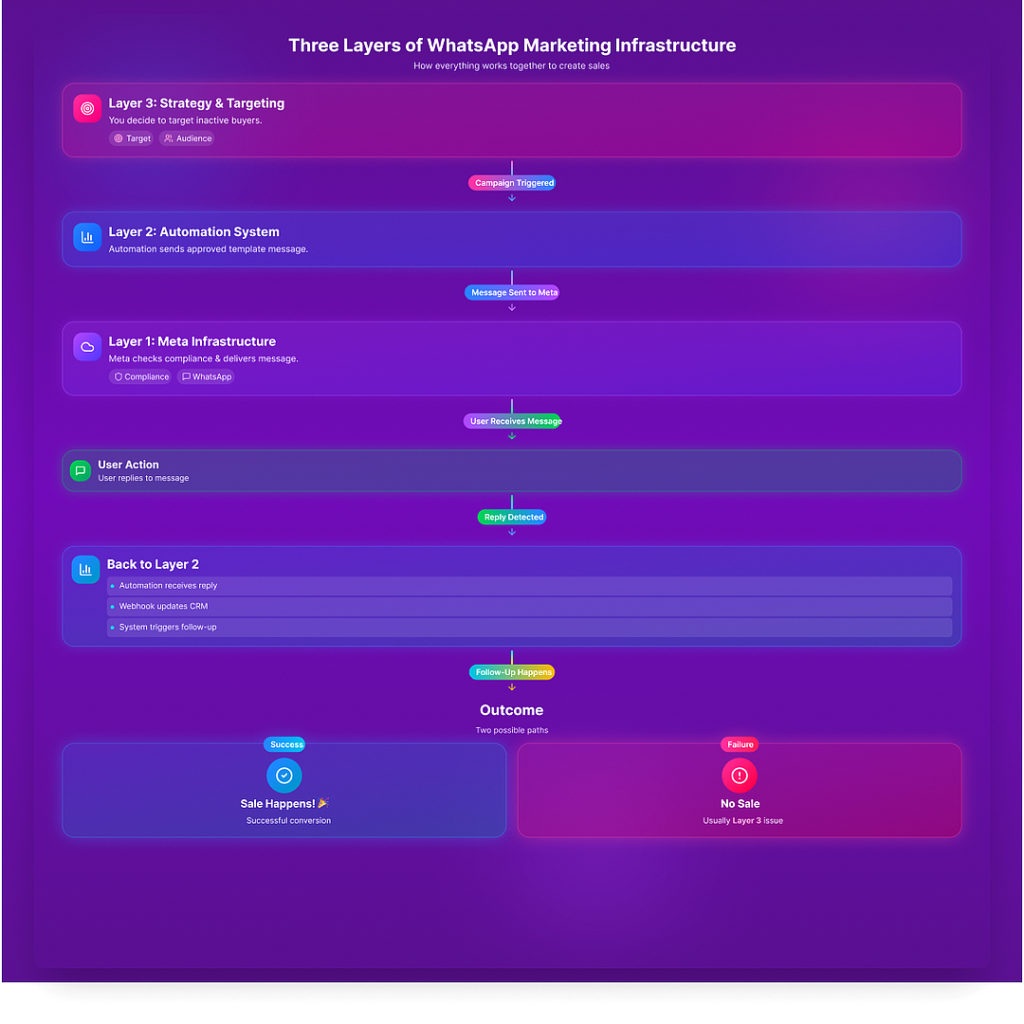
Layer 3 defines whether your WhatsApp marketing system becomes a cost center or a revenue channel.
This is not about sending messages. It is about sending the right message to the right segment at the right time.
Clear CTA. Clear intent. Conversational tone.
When all three layers work together, WhatsApp becomes a permission-based relationship engine, not just a messaging tool.
How Bulk Messaging Actually Works Technically
Many businesses assume bulk messaging means uploading numbers and pressing send. That is not how the system works.
Technically, messaging at scale operates through the WhatsApp Business Platform using APIs. When a business connects through the official channel, messages are routed through Meta’s infrastructure, evaluated for compliance, and then delivered based on quality rating and approval status.
There are two main paths businesses attempt:
| Approach | How It Works | Risk Level | Scalability |
| Official API | Integrated through approved providers | Low if compliant | High |
| Unofficial automation tools | Web scraping, number rotation, cloned sessions | Very High | Temporary |
The difference between unofficial tools and official API is not small. Official systems operate within platform rules. Unofficial systems attempt to simulate user behavior and bypass safeguards.
This is where official vs unofficial WhatsApp systems become important. The official path allows structured scaling, template usage, verified display names, and analytics. Unofficial tools rely on browser automation and expose businesses to risks of using automation software, including detection, quality downgrade, and sudden suspension.
When people search for how WhatsApp marketing works, they often miss this infrastructure layer. Bulk messaging is not just sending. It is part of an engineered system.
From a technical standpoint, bulk campaigns follow this simplified flow:
Opt-in collected → Template approved → API triggers message → Meta reviews → Message delivered → Quality tracked → Limits adjusted
This is part of the broader overall WhatsApp marketing framework and reflects how messaging systems are structured within the platform.
Conversation Based Pricing Explained
WhatsApp does not charge per message in the traditional sense. It uses conversation based pricing.
A conversation begins when a business sends a template message or replies within a user initiated 24 hour window. Pricing depends on the category:
| Conversation Type | Trigger | Purpose |
| Marketing | Business initiated | Promotions, offers |
| Utility | Business initiated | Order updates, reminders |
| Authentication | Business initiated | OTP, verification |
| Service | User initiated | Customer support |
The whatsapp marketing cost structure depends on conversation type and region. Marketing conversations are generally higher in cost compared to utility or service.
Business owners must understand this before budgeting. Sending 10,000 messages does not mean paying for 10,000 individual texts. It means paying for conversations opened under specific categories.
Misunderstanding pricing leads to unrealistic ROI expectations.
Compliance, Templates and Approval Structure
The system is compliance driven.
Before sending marketing messages outside the 24 hour window, businesses must submit templates for approval. Each template is reviewed for:
- Intent clarity
- Promotional language
- Policy alignment
- Spam indicators
This is part of understanding WhatsApp campaign infrastructure.
Templates are categorized. Once approved, they can be used at scale. If rejected, they must be edited and resubmitted.
The whatsapp api setup process includes:
- Business verification
- Display name approval
- Template submission
- Phone number verification
- Webhook configuration
Compliance is not optional. It is embedded in the system.
This is where many compliance risks businesses ignore appear. They assume approval is automatic. It is not.
The whatsapp spam policy clearly defines prohibited behavior such as unsolicited promotions, misleading content, and repeated unwanted contact. Understanding this is essential for avoiding account issues.
Common Mistakes That Lead to Blocking
Most blocking issues are not random. They follow patterns.
Here are the major causes of whatsapp number blocking:
- Sending messages without clear opt in
- Using scraped or purchased databases
- Ignoring template categories
- Sending promotional content in service windows
- Low engagement and high block rate
Businesses often search for why WhatsApp accounts get blocked only after suspension happens. The root cause is usually ignoring system design.
The platform reduces sending limits automatically if engagement drops. Repeated negative signals trigger restriction.
The whatsapp marketing limitations are intentional. They are designed to prevent spam behavior.
If businesses attempt workarounds using unofficial software, the risk multiplies. This ties back to the earlier discussion on risks of using automation software and the gap between official vs unofficial systems.
When Bulk SMS Makes More Sense Than WhatsApp
WhatsApp is not always the correct channel.
Bulk SMS works better when:
- Immediate one way alert is needed
- No prior opt in exists
- The audience is extremely large and transactional
- Regulatory structure favors SMS routing
Comparison:
| Factor | SMS | |
| Consent requirement | Strict | Moderate |
| Rich media | Yes | No |
| Interactivity | High | Low |
| Deliverability to unknown numbers | Restricted | Broader |
| Compliance monitoring | High | Moderate |
The debate of whatsapp broadcast vs api often confuses businesses. Broadcast lists are limited to saved contacts. API allows structured scaling but with compliance.
If your campaign requires immediate reach without deep conversation, SMS may be practical.
Decision Framework for Business Owners
Before investing, ask:
- Do we have genuine opt in data?
- Do we understand conversation pricing?
- Are we ready for structured API integration?
- Do we have a campaign workflow?
- Are we compliant with policy?
A simplified whatsapp campaign workflow looks like this:
Lead Capture → Opt In → Segmentation → Template Strategy → API Trigger → Conversation Handling → Performance Review
This reflects the broader understanding WhatsApp campaign infrastructure that business owners need.
Spending money without clarity on these layers leads to wasted budget.
FAQ
Is WhatsApp marketing legal in India?
Yes, if businesses follow consent rules, template approval, and TRAI related guidelines. Unauthorized bulk messaging without opt in may violate policy and result in suspension.
What is conversation based pricing?
It is a pricing model where charges apply per conversation window category rather than per individual message.
Can I send bulk messages without API?
You can use the Business App manually for small volumes. But structured bulk campaigns require API integration. Attempting scale without API increases compliance risk.
What happens if a number gets banned?
Message delivery stops immediately. Appeal is possible, but restoration is not guaranteed. Repeated violations can permanently damage business reputation.
Is WhatsApp better than SMS for promotions?
It depends on use case. WhatsApp allows rich interaction and engagement. SMS allows broader immediate reach. Channel choice must align with objective.