
A garment business owner from Ahmedabad messaged us last Navratri. Navratri is peak season for them, the time of year when a single WhatsApp broadcast can drive more walk-ins than a week of Instagram ads. His number had been active since March, sending steadily through the year. Then two days before the festival started, the messages stopped delivering. No error. No warning. Just silence.
He had done nothing dramatically wrong. No fake offers, no misleading content. Just a Navratri campaign that went to 6,000 contacts at once, including a large chunk of numbers collected at a textile exhibition eight months earlier who had no memory of ever signing up for anything from him.
That is usually how it goes. Not a single bad decision. A series of small ones that the system finally catches up with.
We have been managing WhatsApp marketing for small businesses across India since the API became more accessible for regional players. Coaching institutes, local D2C brands, kirana-level service businesses, real estate agents who send more messages in a day than most people send in a month. This is written from what we have actually seen happen, not from what Meta’s policy documentation says should happen.
WhatsApp Is Not Reading Your Messages. It Is Reading Your Patterns.
This is the first thing most people get wrong.
When a business owner asks “why did WhatsApp ban me, my messages were completely clean,” they are thinking about content. WhatsApp is not thinking about content at that level. It is looking at behaviour signals, and the two most powerful ones are user-generated reports and automated pattern detection.
What Happens When Someone Taps “Report”
When a recipient blocks and reports a number on WhatsApp, that action registers against the sender’s account quality score. One report does not matter. But if you send to 5,000 contacts and even 2 percent of them hit report, that is 100 signals hitting your account in a short window.
Here is the part most blogs skip: you do not need to send anything offensive to generate reports. In India especially, where people receive dozens of promotional messages daily across every app, many users report simply because they did not recognise the sender. Your perfectly worded Navratri offer is going to get reported if the recipient has no idea who you are.
The system does not know your message was clean. It only knows the outcome.
The Detection That Happens Before Any Report
WhatsApp also monitors outbound patterns independent of user behaviour. An account that normally sends 60 messages a day and suddenly pushes 3,000 in two hours looks, to the system, exactly like a compromised account being used for spam. The ratio of messages sent to messages received is also tracked. Organic business conversations have back-and-forth. Bulk campaigns almost never do.
Ek taraf se sirf messages jaana, aur doosri taraf se kuch nahi aana: that one-sided pattern is a red flag the system watches specifically.
The Opt-In Problem That Indian Businesses Underestimate
Let us talk about something uncomfortable.
A very large number of Indian small businesses are sending WhatsApp marketing messages to lists that were never opt-in verified for WhatsApp specifically. Numbers collected at trade fairs. Excel sheets shared between vendors. Instagram followers whose numbers came from a giveaway form. Customers who shared their number to get an invoice, not to receive promotions.
Internationally, this is understood as a compliance issue. In the Indian market, it has mostly been treated as a minor technicality because “they gave us their number, so they consented.” That interpretation does not hold up on the platform.
What Opt-In Actually Means Here
WhatsApp’s Business Messaging Policy requires that the recipient specifically agreed to receive messages from your business on WhatsApp. Not on email. Not “we may contact you.” On WhatsApp, explicitly.
A customer who bought from your Shopify store and checked a generic “I agree to terms” box has not opted in to WhatsApp messages. A person who followed your Instagram account has not opted in. A number on a list you bought from a data vendor has almost certainly not opted in.
The reason this matters practically, beyond policy, is that non-opted-in contacts are the ones most likely to report you. They genuinely do not know who you are. When they get a WhatsApp message from an unknown business, reporting it is the most natural response.
Scraped Lists Are a Specific Category of Risk
We have had clients come to us with lists of 50,000 numbers scraped from JustDial, Sulekha, or assembled through various grey-market data providers. They want to run a campaign. The honest answer we give them is: you will see delivery for the first few hundred messages, and then the account will start attracting reports fast enough that it will be under review before the campaign finishes.
The platform does not flag scraping directly. It flags the outcome of scraping, which is a large group of people who have no relationship with you receiving messages and responding by blocking and reporting.
Campaign Spikes Look Like Account Takeovers to the System
There is a reason large WhatsApp Business partners ramp up sending volume gradually over weeks before running a major campaign. It is called number warming, and most small businesses skip it entirely.
Why a Single Large Send Is High Risk
When an account’s historical daily average is 200 messages and it suddenly pushes 10,000 in one session, the system’s first interpretation is not “this business is running a big campaign.” Its first interpretation is “this account may have been compromised and is being used for mass spam.”
Think of it like this: agar aapka bank account normally ₹5,000 ke transactions karta hai aur ek din ₹5 lakh ek saath transfer ho, toh bank freeze kar dega. Same logic applies here.
The response is an automatic flag for review. Depending on the account’s existing quality score, that review can result in messaging limits being reduced, or the account being restricted from sending new conversations entirely.
The Frequency Problem Within Campaigns
Beyond volume spikes, sending to the same contact multiple times within a short window compounds the risk. A recipient who gets three messages from the same business number in two days, especially if they did not initiate the conversation, is significantly more likely to report than one who receives a single message. We have seen accounts trip quality limits not from a single big send but from aggressive retargeting sequences run too quickly.
Template Categories Matter More Than the Message Itself
For businesses using the WhatsApp Business API, every message sent outside of a 24-hour customer service window requires a pre-approved template. Most businesses know this. What most do not realise is that the category assigned to the template is enforced, not advisory.
The Three Categories and Why the Line Between Them Gets Blurry
Category | Intended Use | Common Misuse |
Marketing | Promotions, offers, product launches | Everything |
Utility | Order updates, payment confirmations, booking reminders | Disguising promotional content as transactional |
Authentication | OTPs, login verification | Rarely misused |
The temptation to submit a promotional message as a utility template is understandable because utility templates historically had fewer delivery restrictions. But Meta’s review system now specifically checks whether the content matches the declared category. A “payment reminder” that includes a discount code is not a utility message. When caught, the template gets rejected and the account quality takes a hit.
What Happens After Multiple Template Rejections
A pattern of template misclassification goes on the account’s record. It does not immediately result in a ban, but it lowers the quality rating and reduces the account’s messaging tier, which limits how many unique users you can message in a 24-hour window. For a business running time-sensitive campaigns, that tier reduction at the wrong moment is as damaging as an outright ban.
The Account Quality Score: What It Is and Why Most Businesses Ignore It Until It Is Too Late
Every WhatsApp Business account has a quality rating visible inside the WhatsApp Manager dashboard. It shows as Green, Yellow, or Red. Most small businesses running campaigns have never opened this dashboard.
Green means the account is in good standing. Yellow means WhatsApp has flagged quality issues and reduced your messaging tier. Red means you are at risk of losing sending capability.
The score is calculated from block rates, report rates, and user feedback signals collected over a rolling window. A campaign that generates a wave of reports on a Tuesday can move an account from Green to Yellow by Wednesday morning, and if another campaign goes out before the score recovers, it can tip into Red.
At Red, you are not immediately banned, but your ability to initiate new conversations is severely limited. For a business whose entire follow-up process runs on WhatsApp, that limitation alone can stall sales for days.
The Tool You Are Using Might Be the Actual Problem
We have to talk about this directly because it is the cause behind a significant number of the ban cases we see from new clients.
There are dozens of tools in the Indian market, many priced very reasonably, that offer WhatsApp bulk messaging by automating the WhatsApp Web interface. They open a browser session, connect to your WhatsApp account via QR code, and then simulate typing and sending at speed.
Why WhatsApp Detects This Reliably
WhatsApp’s servers monitor session behaviour. A human using WhatsApp Web has natural timing variations between messages. They scroll, they pause, they occasionally make typos. Automation tools do not do any of this. They send at perfectly consistent intervals with no variance, and the absence of human-like variance is itself a detectable signal.
Beyond that, these tools violate WhatsApp’s Terms of Service directly. Using them does not just put a campaign at risk. It puts the phone number itself at risk of permanent ban, which means no recovery, no appeal, and no reuse of that number on WhatsApp Business.
The gray area here is real: some of these tools work for weeks or months before the ban arrives, which makes it easy to believe the risk is exaggerated. It is not. The ban, when it comes, is usually permanent and comes without specific warning.
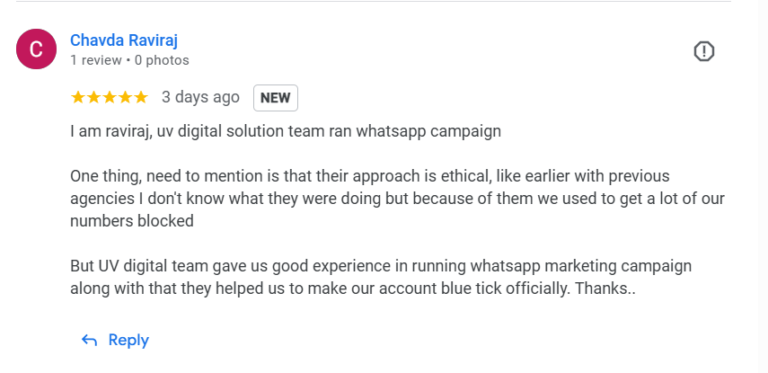
We hear this more than we would like. Raviraj came to us after exactly this situation, and what he noticed was not just the technical fix but the difference in how the work was done
The Difference an Official API Setup Makes
The WhatsApp marketing systems we build for clients operate through Meta’s Business API, which is the only channel Meta considers legitimate for business messaging at scale. API-based sending does not use browser automation. It communicates directly with WhatsApp’s infrastructure through approved endpoints, with rate limits and quality controls built in.
That does not make it immune to account restrictions. But it removes the single largest technical risk, and it gives access to quality monitoring tools that browser automation tools simply do not have.
What Actually Works: How to Run WhatsApp Campaigns Without Losing Your Number
None of what follows is complicated. The businesses we see maintaining healthy accounts over long periods are consistent about these practices, not perfect at them.
Build the Opt-In Before You Need the List
The best time to start building a properly opted-in WhatsApp contact list is before you have a campaign to run. A WhatsApp opt-in checkbox on your order confirmation page, a QR code at your physical location, a “Join our WhatsApp updates” link in your email footer: these build slowly but they produce a list of contacts who actually want to hear from you, and that difference in engagement quality is measurable in report rates.
Warm Up Before Any Large Send
If you have not sent a campaign in weeks, or if you are starting on a new number, do not send to your full list on day one. Send to your most engaged 500 contacts first. Let that settle for a day or two. Then expand. The system’s pattern detection responds to changes in behaviour. Gradual increases do not trigger the same flags as sudden spikes.
Check the Quality Dashboard Before Every Campaign
Before any send goes out, open WhatsApp Manager and check the account’s current quality rating and messaging tier. If you are already at Yellow, running a campaign is likely to push you to Red. Wait for the score to recover, clean the list, and then proceed.
For businesses serious about using WhatsApp as a reliable marketing channel, working with a WhatsApp marketing service that monitors this on your behalf is worth the overhead. The cost of a properly managed campaign is a fraction of the cost of rebuilding from a banned number.
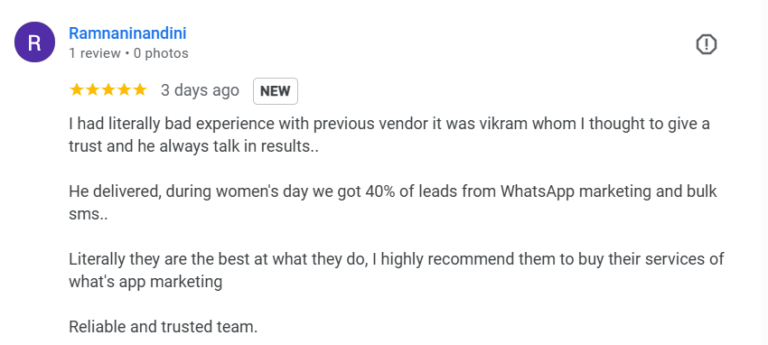
When everything is set up correctly, the results show up in ways that are hard to argue with. During Women’s Day, Ramnaninandini’s business generated 40 percent of its leads through WhatsApp marketing and Bulk SMS alone.
Frequently Asked Questions
My messages were completely appropriate. Why did I still get blocked? Content is only one factor. Block rates, report rates, sending volume spikes, and the tool used to send all contribute to account restrictions independently of whether the message content itself was clean.
Does WhatsApp allow bulk marketing at all? Yes, through the official Business API with approved marketing templates sent to opted-in contacts. Mass sending through WhatsApp Web, automated or manual, is not a supported method and violates the Terms of Service.
Can I recover a restricted WhatsApp Business number? Sometimes. WhatsApp provides an appeal option through the Business Support portal. Accounts restricted for quality issues have a reasonable chance of recovery if the underlying behaviour changes. Accounts banned for Terms of Service violations, particularly those involving automation tools, are much harder to recover.
How many messages can I send per day on WhatsApp Business API? Sending tiers start at 1,000 unique conversations per 24 hours for new API accounts and can scale to 10,000 and 100,000 as the account builds a history of good quality metrics. Tier upgrades are based on messaging volume and quality score, not on time alone.
At UV Digital Solution, we manage WhatsApp marketing campaigns for small businesses across India. If your number has been restricted or you want to set up compliant bulk messaging before your next campaign, you can reach us through our website.